Ashley Thacker
I couldn’t even see myself going anywhere but back to what I know.
“Like Building a Puzzle”
How Ashley Thacker turned curiosity, problem-solving, and a Norwich education into a growing cybersecurity career.
For Ashley Thacker, cybersecurity started with curiosity.
Long before she was monitoring security alerts and responding to incidents in a cybersecurity operations center, she was simply a student who enjoyed working with computers and figuring out how technology worked.
That interest eventually led her into a cybersecurity and networking program during high school, where she was introduced to the world of digital security, computer systems, and cyber defense. It did not take long for her to realize she had found the right field.
“It’s fascinating seeing all the ins and outs of protecting computer systems and networks,” Thacker said.
Today, Thacker is a two-time Norwich University graduate who recently completed her Master of Science in Cybersecurity through Norwich University Online. She currently works for a utility company in a cybersecurity operations center, helping monitor systems, triage alerts, and respond to cybersecurity incidents.
But her path to a career in cyber did not begin with a detailed long-term plan. Like many students navigating the uncertainty of the COVID era, it started with figuring things out one step at a time.
Finding Norwich During an Uncertain Time
Thacker began searching for colleges during her senior year of high school while many schools and students were still adapting to the challenges created by the pandemic.
At the time, she knew she wanted to pursue cybersecurity, but had not narrowed down exactly where she wanted to go. One afternoon, she sat down with her mom and started researching schools with cybersecurity programs across the Northeast.
Norwich University was one of the schools that appeared during that search.
As financial aid offers and tuition estimates started coming back, Norwich quickly separated itself from the other schools she was considering because of its affordability. By the time she visited campus for the first time, she had already committed to attending.
That first trip to Vermont left a memorable impression.
“My very first experience driving up to Vermont was, ‘Oh my God, there’s still snow on the mountains, and it’s May,’” she said with a laugh.
Then came the hills and stairs.
“The very first thing they did was make us walk up that big hill by admissions,” she said. “I looked at my mom and said, ‘I don’t know anymore.’”
Still, any uncertainty disappeared once she settled into campus life.
Building Community Through Cyber and Esports
While completing her undergraduate degree in cybersecurity, Thacker became heavily involved in Norwich’s growing esports program, playing Valorant competitively and helping develop it during its early years as a student esports manager.

Beyond academics, she found a close-knit community where it was easy to connect with classmates, professors, and other students across campus. As a civilian student attending a university known for its military tradition, she appreciated the collaborative environment between military and civilian students and quickly found her place within the Norwich community.
Coming to Norwich initially introduced her to an environment unlike anything she had experienced before.
“You’d be walking to the chow hall, and suddenly there’s a rook squaring around you because you’re too far to the right on the sidewalk,” she said jokingly.
Over time, however, that unique culture became part of what she appreciated most about the university experience.
By the time she completed her undergraduate degree, returning for graduate school felt like a natural decision.
“I couldn’t even see myself going anywhere but back to what I know,” Thacker said. “I had such a good experience the first time.”
Turning Classroom Knowledge Into Real-World Experience
After completing her undergraduate degree, Thacker took about a year away from school to gain professional experience before returning to Norwich for her master’s degree.
Around the same time she began graduate coursework, she also landed her first cybersecurity role. That overlap allowed her to immediately connect what she was learning in the classroom to real-world cybersecurity operations.
Today, Thacker works in a cybersecurity operations center, commonly referred to as a CSOC, where she helps monitor systems, triage alerts, and respond to cybersecurity incidents ranging from compromised accounts to vendor security events and insider threats.
Because her graduate coursework focused heavily on digital forensics and incident response, much of what she studied translated directly into her day-to-day responsibilities.
One of the areas that interested her most was digital forensics, which she describes as similar to solving a puzzle.
“You’re kind of figuring out what people did to put together the pieces to create a timeline,” Thacker said.
That investigative side of cybersecurity is what she ultimately hopes to pursue long-term.
Learning in a Constantly Changing Field
One of the realities of cybersecurity is that the industry evolves constantly. Threats change, attack methods adapt, and new technologies emerge at a rapid pace.

For Thacker, one of the strengths of Norwich’s cybersecurity program was its ability to stay connected to current trends and real-world issues impacting the industry.
During one course, students worked through ransomware case studies, analyzing how attacks occurred, how organizations responded, and where failures happened during the incident response process. The curriculum also strengthened her critical thinking and problem-solving abilities by encouraging students to work through technical challenges independently before seeking assistance.
Outside of traditional coursework, Thacker also found value in Norwich’s integration with Hack The Box, a hands-on cybersecurity training platform that develops technical skills through labs and practical exercises. Combined with her coursework and professional experience, the platform helped reinforce many of the technical concepts she was applying at work.
Balancing Work, Family, and Graduate School
Like many online students, Thacker balanced graduate school alongside work and family responsibilities.
While completing her degree, she was helping care for family members at home while simultaneously adjusting to a demanding rotating work schedule at her new job. Some weeks included overnight shifts stretching late into the evening, forcing her to carefully manage her time around coursework and professional responsibilities.
The online format gave Thacker the flexibility to organize assignments around work shifts and personal obligations without falling behind. She typically focused on discussion posts earlier in the week before transitioning into larger assignments later on.
Even within the online environment, she also found opportunities to build professional relationships with classmates. Students frequently connected on LinkedIn, shared job opportunities, discussed certifications, and supported one another throughout the program.

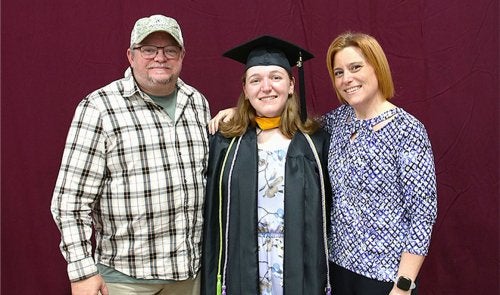
“It was nice to finally meet everybody at graduation,” Thacker said.
In fact, attending graduation became one of the highlights of her Norwich experience and something she strongly encourages online students to experience for themselves.
Looking Ahead
Now that she has completed her master’s degree, Thacker plans to continue building experience within cybersecurity operations while working toward her long-term goal of moving into digital forensics.
She believes the combination of professional experience and graduate education has already helped her stand out within the cybersecurity field, particularly in an industry where continuing education and technical development are increasingly important.
For students considering cybersecurity as a career path, Thacker encourages them not to feel overwhelmed by the size and complexity of the field.
“Be ready to learn,” she said. “But don’t feel like it’s going to overwhelm you.”
Instead, she recommends finding an area of cybersecurity that genuinely interests them and building from there, whether that means penetration testing, digital forensics, incident response, governance and compliance, or another specialization entirely.
As cybersecurity becomes increasingly integrated into everyday life and business operations, Thacker believes the field will only grow in importance.
When asked for a final thought on cybersecurity and its role in today’s world, Thacker’s answer was simple:
“Cybersecurity is everywhere,” she said.