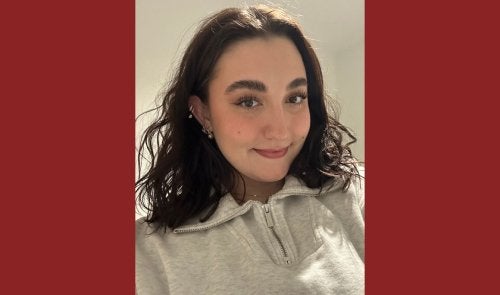
Amna Cicak
"What will stay with me most is the ability to think critically about complex global issues through both theoretical and practical lenses. The program pushed me beyond surface-level understanding into international law, conflict, and humanitarian policy."
Q: "Tell us about yourself: your family, friends, interests, and hobbies."
A: "I am super family-oriented and love to travel! Some of my interests include attending concerts of various genres, playing basketball, and doing arts and crafts."
Q: "Describe your professional background prior to enrolling, what motivated you to pursue this degree, and your long-term career goals."
A: "My professional background was still taking shape when I first applied to Norwich University. At the time, I was working in the school district from which I had graduated, providing one-on-one support to students. Although I had not yet fully defined my career trajectory, I had a longstanding interest in foreign policy and international relations, particularly how states cooperate and conflict within the international system. As a first-generation Bosnian American, I was especially motivated to better understand the Yugoslav Wars, including their historical origins, progression, and long-term consequences.
I earned my bachelor’s degree in History, with a concentration in Holocaust Studies, from the University of Vermont. This academic foundation provided a natural transition into the study of international relations, particularly in areas concerning conflict, genocide, and post-conflict accountability. Shortly after being accepted to Norwich, I took a deliberate step to deepen my historical perspective by spending three months living in Berlin. This experience allowed me to engage directly with sites of profound historical significance and further contextualize my academic interests.
Upon returning, I resumed my role in the school district while also working part-time as a Program Assistant with the U.S. Committee for Refugees and Immigrants, where I supported displaced populations. This experience was pivotal; it solidified my commitment to humanitarian work and provided practical insight into the policies and systems designed to assist vulnerable communities.
Looking ahead, I aim to build a career in humanitarian aid, with a focus on policy implementation and international cooperation. I am particularly interested in contributing to institutions such as the United Nations or NATO, where I can apply both my academic training and professional experience to address complex global challenges."
Q: "How have you applied what you learned in your role, and how has this degree impacted your career growth or direction?"
A: "I applied what I learned at Norwich directly through my work with the U.S. Committee for Refugees and Immigrants. The program strengthened my understanding of international law, refugee policy, and the geopolitical forces shaping displacement. I was better able to contextualize individual cases within larger international frameworks and explain complex policies to clients.
I am also a member of a leadership cohort hosted by the Vermont Council on World Affairs, which has complemented my academic work by connecting me with professionals in international affairs.
The degree clarified my long-term direction from a general interest in international relations to a more focused commitment to humanitarian aid and international policy. It also strengthened my critical thinking, research, and communication skills, which are essential for advancing in this field."
Q: "What will stay with you most from your Norwich experience, and what advice would you give to prospective students?"
A: "What will stay with me most is the ability to think critically about complex global issues through both theoretical and practical lenses. The program pushed me beyond surface-level understanding into international law, conflict, and humanitarian policy. Equally valuable was the exposure to peers from military, government, and international backgrounds, whose perspectives made discussions far more dynamic.
For prospective students: approach the program with intention. The online format offers flexibility, but success depends on being proactive and fully engaged. Connecting course material to your own professional interests whenever possible makes the learning more meaningful and relevant. I also encourage students to view the program as an opportunity to refine their long-term goals, not just fulfill a requirement.
Is there anything else you would like to tell us about your experiences at Norwich or the impact of Norwich on your life?
As a first-generation Bosnian American, my academic journey has always been tied to understanding conflict, displacement, and accountability. Norwich gave me the structure and intellectual framework to explore those interests with greater depth and focus, connecting my personal background to broader questions in international law and humanitarian response.
The program also gave me greater confidence in contributing to policy-oriented discussions and working within complex international environments. That clarity has extended into my professional life and continues to shape my goals."
Q: "Why did you choose Norwich University Online? What influenced your decision to pursue an online program, and which aspects of the online learning experience proved most beneficial to you?"
A: "My decision was driven by Norwich's academic reputation and the flexibility the online format offered. At the time, I was working in education and later in refugee assistance, which made attending an in-person program impractical. Norwich's program connected theory to real-world application, particularly in international law, conflict, and humanitarian policy, which aligned with my background in history and Holocaust studies.
Norwich's history of producing leaders in the military, government, and public service also motivated me. The online experience allowed me to immediately apply what I was learning to my work with the U.S. Committee for Refugees and Immigrants, and engaging with peers from diverse backgrounds enriched every discussion."
Q: "What were your expectations before starting the program? How did your experience compare, and what aspects stood out most to you?"
A: "Before beginning, I expected a rigorous academic environment that would deepen my understanding of international relations while allowing me to balance professional responsibilities. I anticipated a strong theoretical foundation and hoped the program would connect to contemporary issues in international law and humanitarian policy.
My experience exceeded those expectations. Courses incorporated case studies, policy analysis, and current events, allowing me to connect academic material to real-world situations. The online discussions were substantive and enriched by classmates with backgrounds in the military, government, and international service. The emphasis on writing, research, and critical analysis sharpened my ability to construct well-supported arguments and engage with complex international topics."