Bachelor of Science in Cybersecurity
For people already working in IT, or coming out of a technical military role, who want the degree that opens doors to security work. Choose digital forensics or information warfare, and finish with up to 12 graduate credits already banked.
A security degree from a school the NSA and DHS designated for it
Cybersecurity hiring has a credential problem. The work is practical; the job postings ask for a degree anyway, and plenty of people already doing the work cannot get past the filter. This degree is built to clear that filter, and it is built for someone already working in IT rather than someone starting from zero.
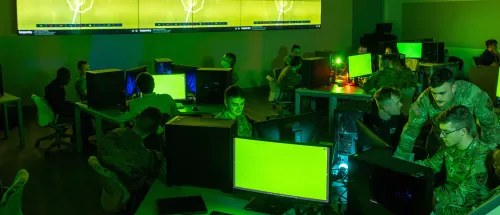
The coursework is hands-on: programming, Windows and Linux administration, networks, and information assurance, alongside the law, ethics, and writing that separate a security professional from a technician. Then you choose a concentration, digital forensics or information warfare, and that choice is what the degree ends up being about.
It finishes with a six-credit capstone where you take a real organization's security posture apart and present the analysis. It is the one piece of the degree you cannot transfer in, and the one you will be talking about in interviews.
Norwich has held a National Center of Academic Excellence in Cyber Defense designation since 2001 and is accredited by the New England Commission of Higher Education.
See what your previous experience can get you
Bring up to 90 credits, and find out what they are worth before you apply
- 120 credits for the degree, up to 90 of them transferred in
- A 42-credit security core: programming in both high and low level languages, Windows and Linux administration, networks, databases, information assurance, cyber law, and ethics
- Then a six-course concentration, in digital forensics or information warfare
- The six-credit Cyber Capstone has to be done here. It cannot be satisfied by transfer credit, and it comes last
- Credit can come from prior coursework, military training, CLEP exams, and assessed professional experience, and IT certifications you already hold are worth asking about.
Hack The Box Certifications
In partnership with Hack The Box (HTB), as a Norwich University student, you will gain access to the world-class platform to experience hands-on, real-world cybersecurity challenges aligned to industry standards. In addition to the cybersecurity degree, you will earn certifications that directly align with DoD job roles, offering you an edge in securing critical positions in federal agencies.
The industry-recognized certifications include:
- Certified Active Directory Pentesting Expert (CAPE)
- Certified Defensive Security Analyst (CDSA)
- Certified Junior Cybersecurity Associate (CJCA)
- Certified Penetration Testing Specialist (CPTS)
- Certified Web Exploitation Expert (CWEE)
- Certified Web Exploitation Specialist (CWES)
- Certified Wi-Fi Pentesting Expert (CWPE)