Mitchell Tray
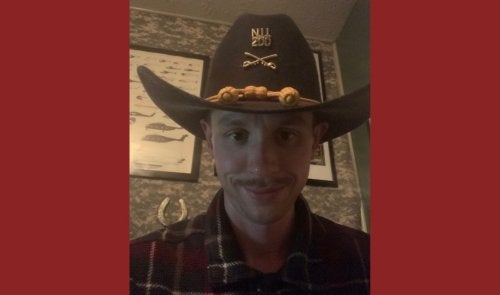
"Though I was initially frustrated by returning to school, I am grateful for what I learned. I also plan to explore career paths in government analysis that draw on critical thinking.""
Q: "Tell us about yourself: your family, friends, interests, and hobbies."
A: "First and foremost, I am a collector of books, fiction and nonfiction alike, accumulated from professors, bookstores, and gifts over the years. My interest in collecting is rooted not only in a love of reading but in preserving knowledge for the future. My other hobbies include tabletop gaming, target shooting, and long runs. My family has been a source of steadfast support throughout my time in the program, and my friends, from high school, college, my current work at Guinness, and the Army Reserve, have all played a role in helping me grow."
Q: "Describe your professional background prior to enrolling, what motivated you to pursue this degree, and your long-term career goals."
A: "I graduated from Norwich in 2019 with a bachelor's degree in Studies in War and Peace and a minor in philosophy. After graduation, I served on active duty from 2019 to 2022, then transitioned to the Army Reserve. I pursued this master's degree to apply my love of history toward roles in libraries, museums, or archival institutions that both preserve and share knowledge, and that typically require a master's degree for entry. Though I was initially frustrated by returning to school, I am grateful for what I learned. I also plan to explore career paths in government analysis that draw on critical thinking."
Q: "How have you applied what you learned in your role, and how has this degree impacted your career growth or direction?"
A: "The impact of this degree on my career direction has been one of further insight into critical thinking skills and analysis, and how they can be applied to a wider range of possible career paths. Though many of my lessons have centered around history, the lessons from my courses have allowed me to investigate and pursue new career fields. Moreover, as a student of history, being able to gain more knowledge in this particular field has been extremely beneficial."
Q: "What will stay with you most from your Norwich experience, and what advice would you give to prospective students?"
A: "What will stay with me is the confidence I built in researching and writing at a graduate level, a step well beyond what I accomplished as an undergraduate. This experience has also given me new perspectives on history that I plan to keep exploring.
My advice: map out your assignment due dates from day one so you are never rushing. Build a relationship with the library and writing center staff; both are invaluable. Do not be discouraged by feedback on early drafts; those corrections are how your final work improves. And know your limits, working at a sustainable pace leads to better results."
Q: "Is there anything else you would like to tell us about your experiences at Norwich or the impact of Norwich on your life?"
A: "I would say in closing that as an undergrad, Norwich helped me find my people, and as a graduate student, Norwich helped me find out more of what I could achieve and understand."
Q: "Why did you choose Norwich University Online? What influenced your decision to pursue an online program, and which aspects of the online learning experience proved most beneficial to you?"
A: "Part of my decision came down to familiarity. Norwich remembered who I was as an undergraduate, and I still had connections to staff on campus, including Ms. Veach in the library. The online format allowed me to continue working on the civilian side and stay active in the Reserve. The program deepened my understanding of how history is recorded and interpreted, and introduced me to museum studies as a potential career path. As a soldier, courses in military thought and theory have made me a more informed NCO, and my capstone research into the history of Army Basic Combat Training shed new light on my own experience as a recruit."
Q: "What were your expectations before starting the program? How did your experience compare, and what aspects stood out most to you?"
A: "I was apprehensive going in, it had been six years since I had written a research paper. That nervousness stayed with me at different points throughout, but I grew more confident with each assignment. The aspect that stood out most was completing papers of far greater length and complexity than anything I had produced as an undergraduate, culminating in my capstone, the longest piece of writing I have ever completed."