Michael Ortiz
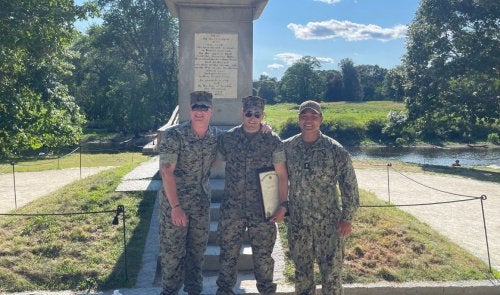
"I was not sure if I would be able to handle the workload and balance the competing demands. But I did, and I am glad I took that step."
Q: "Tell us about yourself: your family, friends, interests, and hobbies."
A: "I am a Staff Sergeant and Platoon Sergeant with the 25th Marine Regiment, with a decade of service in the United States Marine Corps. I am primarily trained as a Field Wireman and have cross-trained as a CBRN Defense Specialist and Combat Marksmanship Coach. My service has included humanitarian assistance missions in South America and engagements with Scandinavian partners, experiences that broadened my understanding of multinational cooperation and relationship-building.
Service runs in my family. Two of my sisters are combat veterans. After transitioning to the Marine Corps Reserve, I earned a Bachelor of Science in Emergency Management and Occupational Health and Safety from Massachusetts Maritime Academy and built a career as a safety professional in the construction industry in the Boston area. I hold certifications including CSP, CHST, and STSC.
Outside of work, I have a strong interest in 18th-, 19th-, and 20th-century history and enjoy science fiction, which I find offers a useful lens on leadership, ethics, and human potential."
Q: "Describe your professional background prior to enrolling, what motivated you to pursue this degree, and your long-term career goals."
A: "When I completed my bachelor's degree, I knew I wanted to pursue a master's degree. Norwich University was the first institution that came to mind, given its history and strong ties to military leadership development.
I chose to study leadership after witnessing firsthand how poor leadership could derail large-scale operations, including a $400 million project. Many of the problems I observed were not technical; they were rooted in leadership failures. That realization drove me to pursue this program with real purpose. My goal is to use what I have learned to foster a strong safety and performance culture and lead teams in a way that drives both efficiency and long-term success."
Q: "How have you applied what you learned in your role, and how has this degree impacted your career growth or direction?"
A: "In my role, I have learned that jobsite safety must be more than just rules and compliance - it needs to be built into the culture. For a safety culture to actually take hold, it requires strong leadership. People take their cues from leadership, so if leaders are consistent, engaged, and set the standard, the workforce will follow.
Through my program, I have been able to apply more of a leadership-focused approach to safety rather than just enforcement. I spend more time communicating with crews, building relationships, and reinforcing expectations in a way that gets buy-in instead of just compliance.
This has helped me grow professionally by shifting how I see my role - not just as an enforcer, but as someone who helps shape the overall culture on a project. It has also helped guide me toward pursuing higher-level leadership roles where I can have a bigger impact."
Q: "What will stay with you most from your Norwich experience, and what advice would you give to prospective students?"
A: "What will stay with me most is the people and the shared mindset. Being surrounded by driven professionals from a wide range of backgrounds created an environment where real-world experience shaped every discussion. That made the learning practical, not just theoretical, and reinforced that leadership is something you practice every day.
My advice to prospective students is to fully commit. Engage in discussions, connect with your peers, and challenge your own thinking. Managing your time carefully, balancing work, school, and life, is demanding, but if you put in the effort, you will walk away with skills and perspectives you can apply immediately."
Q: "Is there anything else you would like to tell us about your experiences at Norwich or the impact of Norwich on your life?"
A: "Norwich's alumni network stood out even before I graduated. Mentioning that I was attending Norwich immediately created a connection with others who had been through the program. Those initial conversations turned into meaningful professional relationships with people who were open, willing to share advice, and genuinely invested in helping one another succeed. That kind of network extends well beyond the classroom."
Q: "Why did you choose Norwich University Online? What influenced your decision to pursue an online program, and which aspects of the online learning experience proved most beneficial to you?"
A: "Working 40 to 60 hours per week, plus my obligations to the Marine Corps Reserve, the asynchronous format at Norwich is the most convenient program I have taken. I can complete work on my own schedule, without being tied to a specific time, day, or location."
Q: "What were your expectations before starting the program? How did your experience compare, and what aspects stood out most to you?"
A: "I was nervous about starting a graduate program while working full-time. I was not sure if I would be able to handle the workload and balance the competing demands. But I did, and I am glad I took that step.
What stood out most to me was the quality and diversity of my peers. Many were current or former military members or worked in government roles, while others were professionals from a wide range of industries pursuing the same level of education and growth that I was. That mix created a strong dynamic in discussions and team projects, bringing in different perspectives and real-world experiences. It also opened the door to valuable networking opportunities that I know will extend well beyond the program."