Adam Thompson
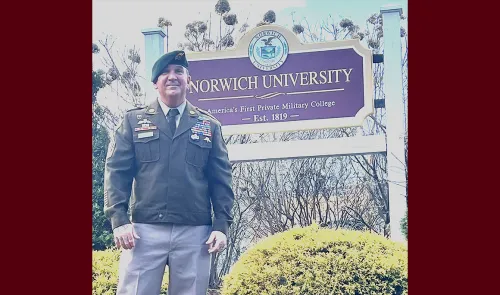
With Norwich, I was applying what I learned immediately. There’s value in academic rigor. It’s not for everybody, and that’s part of the appeal.
Purpose Built: Adam Thompson on Service, Strategy, and Why Norwich Online Matters
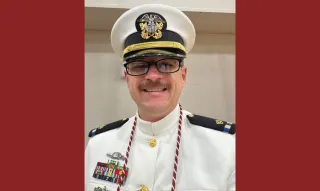
After nearly 30 years in the U.S. Army and a career shaped by Special Operations, Adam Thompson does not talk about education as a credential. He talks about it as preparation. Something earned. Something tested. Something that allows leaders to keep contributing when experience alone is no longer enough.
Originally from Sacramento, California, Thompson entered the Army in 1997. He began his career as a paratrooper in the 82nd Airborne Division before spending the remainder of his service in the Special Operations community. Over time, his responsibilities expanded, and with them came a shift in how leadership was measured.
“There’s a point where the tactical side only gets you so far,” Thompson said. “If all you bring is door kicking and jumping, you’re going to burn out.”
For Thompson, education became the difference between plateauing and continuing to grow as a senior enlisted leader. It shaped how he advised commanders, how he thought strategically, and how he prepared for increasingly complex environments.
Why Education Matters in Special Forces
Special Forces operates on trust, reputation, and peer assessment. Thompson describes the community as tribal, where decisions are influenced as much by observation as by formal requirements.
“We look closely at our peers,” he said. “How they operate, how they think, how they develop.”
That matters because Special Forces is NCO-driven. Senior enlisted leaders carry continuity, institutional memory, and often the responsibility to translate complex information into actionable advice for commanders.
“To be effective, you have to be comparably educated with your commander,” Thompson explained. “Especially in today’s strategic environment.”
In his experience, education is not optional at senior levels. It is often expected. At the E-8 level, he recalls being told plainly that a bachelor’s degree was necessary to be competitive for E-9. In some cases, it was decisive.
But Thompson’s motivation went beyond promotion. He wanted to contribute meaningfully at the strategic level and to demonstrate to younger soldiers that learning mattered.
“I earned my bachelor’s degree while deployed, between deployments,” he said. “I wanted soldiers to see that education isn’t separate from leadership. It’s part of it.”
Choosing Norwich and the SSDA Program
Thompson’s decision to attend Norwich University was shaped by what he saw working in his own community. Many of the senior enlisted leaders he respected most had one thing in common. They were Norwich graduates, often from the Strategic Studies and Defense Analysis program.
“A lot of the SOCOM command cells were filled with Norwich and SSDA grads,” he said. “That mattered.”
What stood out was not just where those leaders studied, but how they performed. Thompson watched Norwich-educated leaders engage confidently at the highest levels.
“They could sit with three- and four-star generals and hold their own,” he said. “Sometimes they even outpaced them intellectually.”
For Thompson, that was proof that the program prepared leaders for strategic environments, not just academic discussions. Courses on conflict, security, and religion consistently aligned with real-world challenges he was already facing.
“It was mutually beneficial,” he said. “I was solving real problems at work while completing my degree.”
Education Applied to Operations
Thompson’s capstone project offers a clear example of how Norwich’s SSDA program connects theory to practice. He focused on resource exploitation in West Africa, examining illicit fishing operations near Côte d’Ivoire and the broader effects of mineral extraction tied to China’s Belt and Road initiatives in Nigeria.
At the time, Thompson knew he was heading into a new role as Operations Sergeant Major at Special Operations Command Africa. He intentionally aligned his academic work with the challenges he would soon face.
“I used the capstone to help the command,” he said. “It wasn’t just academic. It was forward thinking.”
Norwich encouraged that approach by allowing students to focus on geographic combatant command problem sets. Academic research became a tool for operational planning, not a separate exercise.
“That made a huge difference,” Thompson said.
Learning Online in a Combat Environment
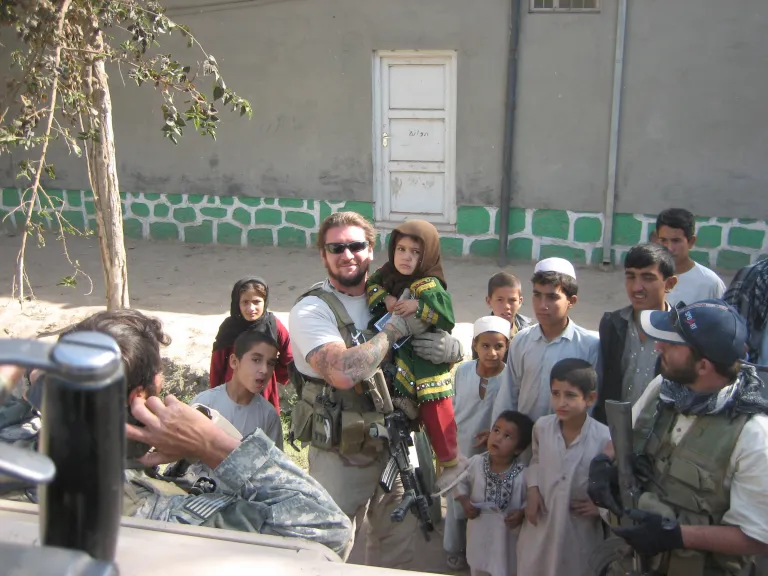
For Thompson, Norwich Online proved itself under real conditions. While deployed at a Forward Operating Base, indirect fire struck his living quarters, destroying his laptop. He and others were unharmed, but his ability to complete coursework was suddenly uncertain.
“It sounded like an excuse,” he said, laughing. “My laptop was destroyed by a mortar attack.”
Thompson contacted his student support advisor and explained the situation. The response was immediate and supportive.
“The student advisors were amazing,” he said. “They were responsive and made you feel like you were part of the institution.”
As a first-generation college graduate, Thompson was especially sensitive to how online students are treated. He never felt like Norwich viewed online education as lesser.
“They didn’t make you feel like you weren’t really there,” he said. “If anything, it felt more demanding.”
That support became even more tangible when his Tuition Assistance ran out. Norwich quickly offered the Sergeant’s 3 Scholarship, allowing him to continue without pausing his education.
“It took about 48 hours,” he said. “I haven’t seen that anywhere else.”
Thinking Differently as a Leader
Returning to school after a long gap was not easy. Thompson had not taken formal coursework since high school when he began his degree.
“What Norwich helped me do was relearn how to think,” he said.
The program sharpened his analytical approach. He began breaking down problems by environment, defining the issue clearly, and evaluating approaches. Over time, that structure became instinctive.
“You don’t realize you’re doing it,” he said. “But it carries over into everything.”
He also valued being challenged independently. Without the usual operational planning teams to lean on, he had to do the intellectual work himself.
“That was beneficial,” he said. “It made me more deliberate.”
Purpose Over Convenience
When Thompson advises service members considering education, he returns to one theme repeatedly: purpose.
“Be purposeful in choosing your degree,” he said.
He has seen peers pursue degrees simply to meet requirements, only to find that the education did not translate into meaningful work later. Without interest or relevance, students often focus on survival rather than growth.
“With Norwich, I was applying what I learned immediately,” he said.
He does not shy away from the program’s rigor. Norwich was harder than some alternatives, and that mattered to him.
“There’s value in academic rigor,” Thompson said. “It should mean something.”
As a first-generation college graduate, what hung on his wall mattered. Norwich’s history, lineage, and long-standing relationship with the Special Operations community carried weight.
The Alumni Network and Earned Trust
Thompson describes the Norwich alumni network as quiet but powerful. Within Special Operations, SSDA graduates are visible in senior roles, and their presence often speaks for itself.
“When you meet someone who finished the program, you know what it took,” he said.
The difficulty of the program, particularly courses like statistics, became a filter. Some started and did not finish. Those who did earned a shared understanding.
“It tells you a lot about someone without them saying much,” Thompson said.

Outside the military, Thompson began engaging the broader alumni network more recently. At an alumni event in Tampa, he was welcomed immediately, despite completing his degree online.
“I never felt like a second-class alum,” he said.
Values That Align
For Thompson, Norwich’s values align naturally with military service. As the oldest private military college, Norwich represents standards that are upheld over time.
“It’s not for everybody,” he said. “And that’s part of the appeal.”
He rejects the idea of Norwich as a degree mill. Standards matter, and students are expected to meet them.
“There are values and expectations,” he said. “You either meet them, or you don’t.”
He has met many senior officers who completed the full cadet experience at Norwich. His assessment is consistent.
“They’re talented, humble, and effective,” he said.
Why He Continues to Serve Norwich
After retiring from the Army, Thompson transitioned into an academic leadership role at Norwich. For him, it felt like a continuation of service.
“Norwich meant a lot to me,” he said. “Earning my degree there is one of my top achievements.”
He also carries a story that shaped that decision. Years ago, while being treated at the TBI clinic in Landstuhl for shrapnel behind his eye, Thompson met an eye doctor whose brother was the first Norwich graduate killed in Operation Iraqi Freedom. She had chosen to work there because she felt called to serve wounded service members.
“That stayed with me,” Thompson said. “It reminds you what institutions really represent.”
Graduation and Reunion
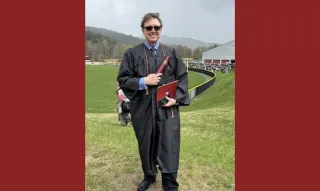
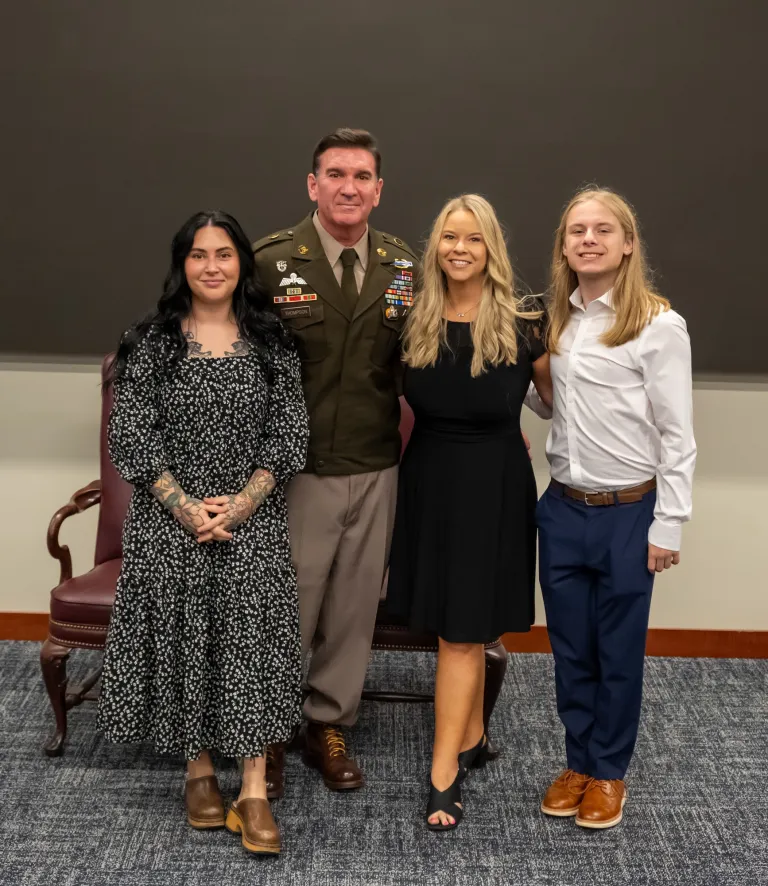
Thompson was scheduled to graduate in May 2020, but COVID prevented travel. Years later, Norwich invited him and his wife to campus during graduation season.
“They treated us incredibly well,” he said.
Wearing his uniform on campus, reconnecting with faculty, and unexpectedly seeing fellow Green Berets in uniform underscored the meaning of the degree.
“When senior enlisted leaders and officers show up on their own time to walk,” he said, “that tells you everything.”
He described the experience simply.
“It felt like a reunion.”
Advice to Service Members
For service members considering an online degree, Thompson emphasizes camaraderie, challenge, and long-term value.
“You build real connections,” he said. “Even with people you’ve never met in person.”
The shared difficulty creates common ground that lasts well beyond graduation.
“Choose something purposeful,” Thompson said. “Choose something that will matter when the uniform comes off.”

Looking ahead, he plans to pursue graduate study, with International Relations among the programs he is considering.
For Thompson, learning did not end with retirement. It simply shifted focus.
Norwich helped him think more clearly, lead more effectively, and stay connected to a community that understands what it means to earn something the hard way.