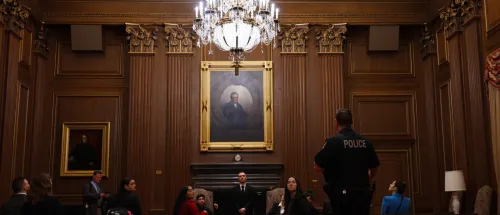
Police officer stands before seated people in a wood-paneled courtroom with a chandelier and framed portraits.

Bachelor of Science in Criminal Justice

Procedure tells you what to do. This degree tells you why: the law behind a search, the research behind a policy, and the ethics behind the hardest calls anyone in the field has to make.

Whether you are starting out, changing direction, or already working in criminal justice, there are six start dates a year to begin from.

The degree for the part of the job nobody trained you for

Academy training teaches you procedure. This degree teaches you the system the procedure sits inside: why the law reads the way it does, what the research says actually reduces crime, and how the constitutional history behind a search or a stop was decided.

The core runs 36 credits across criminal justice and criminology, criminal procedure, the history of the US Constitution, social science research methods, statistics, criminal justice ethics, and intercultural communication for law enforcement. It closes with a senior seminar where you research and argue a real issue in the field. Then 18 credits of your own choosing let you angle the degree toward intelligence, cybercrime, forensics, or policy.

Norwich has been training people for public service since 1819 and is accredited by the New England Commission of Higher Education.

Support Courses

See what your previous experience can get you 

Bring up to 90 credits, and find out what they are worth before you apply

  • Up to 90 credits transfer in from prior coursework, military training, CLEP exams, and assessed professional experience. See what transfers
  • A 36-credit core: criminal justice, criminology, criminal procedure, constitutional history, research methods, statistics, ethics, and a senior seminar
  • Plus 18 credits chosen from a list of related courses, which is where you point the degree at intelligence, cybercrime, forensics, or policy
  • Police academy training, military police and investigative roles, and corrections experience are all worth asking about. Send what you have, and we will assess it

Send a transcript and a resume, and we will tell you which requirements you have already met, what is left, and how many terms that is; no application required.

See what transfers

Fast Facts

18

Months

Average completion time for the Bachelor of Science in Criminal Justice

90

Credits

Transfer in up to 90 credits before you start.

100%

Online

Complete your bachelor's completely online with access to your classroom 24/7

Frequently Asked Questions

Eighteen credits of the degree are yours to choose from a list that includes intelligence studies, cybercrime and cyber law, forensics, and policy. That is where you angle the degree toward the work you want. An advisor will help you build a set that holds together rather than a scatter of electives. Additionally, training reviewed by the American Council on Education converts to semester credit, academy certificates and professional certifications can be assessed too. Send them with your transcript and ask for everything to be evaluated at once.

Undergraduate Admissions

That is the assumption the program is built on. There are no scheduled class meetings; you take 3 to 12 credits per term, depending on what you can carry, and there are several start dates a year. Eighteen months is the average, and your own number depends on what you transfer in. Don't just take our word for it; check out what our alumni have to say.

Alumni Stories

Yes. This is a degree program, so federal financial aid applies if you are eligible, alongside military tuition assistance, veterans' benefits, and employer reimbursement.

Ways to Pay

Next Undergraduate Session Start Dates: 

Fall B: October 26, 2026

Spring A: January 18, 2027

Spring B: March 15, 2027

Next Undergraduate Session Application Deadlines: 

Fall B: October 16, 2026

Spring A: January 8, 2027

Spring B: March 10, 2027


Apply Now

Alumni Testimonials

Brad Hanson

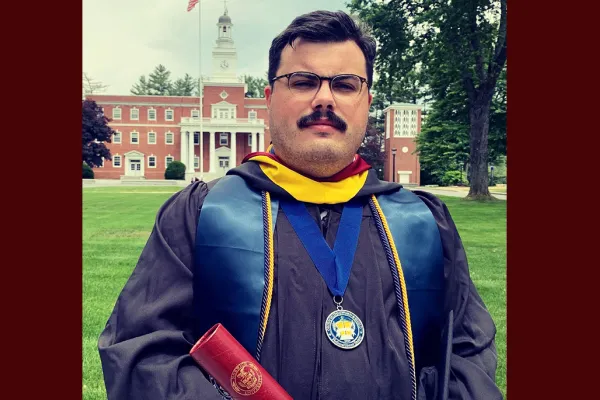
I wholeheartedly feel that my Norwich education was one of the final deciding factors that led to my “dream job” with the Vermont State Police.

Brad Hanson

'18 Bachelor of Science in Criminal Justice

Read Story
Julie Scribner

One of the key things to me for having a Norwich education is the name that comes with it; there’s pride and tradition that comes with having a Norwich University diploma.

Julie Scribner

'15 Bachelor of Science in Criminal Justice

Read Story
Kelley Lawrence headshot

I have always dreamed about graduating from Norwich University. Going to college was always on my bucket list and this was my motivation.

Kelley Lawrence

'16 Bachelor of Science in Criminal Justice

Read Story
hero-image

Everyone at Norwich was great. Even the admissions office and registrar went above and beyond to help me get through it.

Emerson Sullivan

'18 Bachelor of Science in Criminal Justice

Read Story
Ryan Leonard

Every advisor, teacher, and counselor throughout my degree completion was heavily invested in helping me succeed in the classes and helping me to craft and refine the skills [needed] for a career in national security.

Ryan Leonard

'21 Bachelor of Science in National Security Studies

Read Story
Brad Hanson

Brad Hanson

Julie Scribner

Julie Scribner

Kelley Lawrence headshot

Kelley Lawrence

hero-image

Emerson Sullivan

Ryan Leonard

Ryan Leonard

Faculty & Staff

Join professionals from around the globe and learn from experienced faculty as you complete your degree and open up new professional and personal possibilities for yourself.

Page C. Spiess

Page Spiess

Position(s):

  • Associate Vice President of Academics, CGCS
  • Assistant Professor
cara bertin headshot

Cara Bertin

Position(s):

  • Associate Program Director
  • Student Support Advisor

Career Outcomes

See where a Norwich Online Bachelor of Science in Criminal Justice could take you. All three of these roles list a bachelor's degree as the typical entry requirement, which is the wall this degree gets you over.

Source: U.S. Bureau of Labor Statistics Occupational Outlook Handbook, May 2025 median wage data.

  • Detectives and criminal investigators
    $93,790

    Police officers protect lives and property. Detectives and criminal investigators gather facts and collect evidence of possible crimes.

    View the BLS
  • Probation Officers and Correctional Treatment Specialists
    $66,270

    Probation officers and correctional treatment specialists assist in rehabilitating law offenders in custody or on probation or parole.

    View the BLS
  • Paralegals and Legal Assistants
    $62,890

    Paralegals and legal assistants support lawyers by performing a variety of tasks, such as maintaining and organizing files, conducting legal research, and drafting documents.

    View the BLS

Admissions Details

At a Glance

  • Transfer up to 90 credits
  • Multiple start dates per year


Contact Admissions

Monday - Friday: 8 a.m. to 4:30 p.m. EDT    
Extended hours available by appointment

Call: 1-888-409-1480   
learn@norwich.edu

Transfer Credits


You may receive the equivalent of up to 90 semester credits for training and prior learning that meet specific course requirements in the program.
Learn more »

International Admissions


Norwich University welcomes students from all countries who want to study through our online programs. You must complete all steps in the admissions process.
International Admissions »

Norwich Alumni Benefits


Reconnect with Norwich to complete your master's degree. As a part of our alumni community, you are eligible for a $2,500 scholarship and other benefits.
Connect with our advisors »

Non-Discrimination Statement

Norwich University, in compliance with Title IV of the Civil Rights Act of 1964, Title IX of the Education Amendment of 1972, and Section 504 of the Rehabilitation Act of 1973, does not discriminate on the basis of race, religion, color, national origin, age, sex, or physical handicap in any of its policies, practices, or procedures.

NECHE Accredited

 Norwich University is accredited by the New England Commission of Higher Education (formerly the Commission on Institutions of Higher Education of the New England Association of Schools and Colleges, Inc.).

Eligibility Requirements

  • Meet one of the following criteria:
    • Prior college courses, completed with a grade of C or better, from regionally or nationally accredited institutions of higher learning, or the equivalent from a foreign institution, as evaluated by a NACES approved agency.
    • ACE-reviewed military or professional training for which college credits are recommended.*
    • Other military or professional training reviewed by Norwich University for which college credit has been assessed, or is stipulated in a MOU.
    • Credit recommended based on scores on standardized tests such as CLEP.
    • High school diploma or equivalent GED.
  • If English is not your first language, proof of English language proficiency is required. This can be demonstrated in one of three ways:
    • TOEFL - a minimum score of 550 (paper-based test) or 80 (Internet-based test) on the TOEFL is required unless otherwise noted in specific articulation agreements.**
    • IELTS – a minimum composite score of 6.5 is required.**
    • Duolingo - a minimum score of 110 is required.
    • Successful completion of an associate’s degree from an accredited U.S. higher education institution.

*Prospective students who have completed military or professional training that has not been ACE reviewed may petition to Chair of Continuing Studies to have their training reviewed and assessed for transfer credit.

Please Note: All eligibility requirements are expected to be met unless noted in specific articulation agreements or memoranda of understanding (MOUs).

SPECIAL NOTE TO NORWICH UNIVERSITY RESIDENTIAL STUDENTS:

  • If you are a residential undergraduate student at Norwich University, you may enroll in CGCS courses only with written permission of the Dean of the College of Graduate of Continuing Studies, your undergraduate advisor, and your major undergraduate department chair and/or dean via the petition to enroll at CGCS form on the registrar's webpage.

Admissions Process

To apply, you must submit the following no less than four weeks prior to your desired start date:

  • Application form
  • Resume is required if applying for transfer credit.
  • Official military training transcripts (Joint Services Transcript/CCAF), sent to the address below.
  • Official transcripts of all courses taken at regionally accredited colleges, sent to the address below.
  • If entering with no military or college credit, applicants must show proof of high school completion via diploma or GED.

Transcript Links

Mail transcripts to:
Norwich University
ATTN: CGCS
158 Harmon Drive
Northfield, VT 05663

For electronic delivery, we accept transcripts delivered from Parchment, National Clearing House, and other services if sent to cgcsamt@norwich.edu via password protection.

To contact an admissions advisor:

Call: 1-888-409-1480
Email: learn@norwich.edu

Norwich University Online's Bachelor's programs are an investment in your future that we can help you manage from a financial perspective. There are many ways to get financial assistance and many strategies that can help you achieve your goals. Whatever your individual situation, we can guide you through the financial planning process.

Tuition at a Glance
Credit Hours: 30-120
Credits per Term: 3-12
Cost Per Credit Hour: $250 - $415
Additional fees & military discounts may apply.


Financial Aid Resources
Paying for your Education

Program Requirements

The Bachelor of Science in Criminal Justice program can be completed over the course of 18 to 24 months. For a Norwich bachelor's degree, you must earn at least 120 semester credits, including transfer credits.

For full course listings, requirements, and registration information, head to the Norwich University Course Catalog.